


How long does a Subaru CVT last in Las Vegas heat?
100,000 to 200,000 miles on the original hardware, as long as the fluid stays on schedule. The catch for Las Vegas owners is that Subaru's published fluid interval was written for a national average. Out here, you'll want to service it sooner than the sticker says.
Subaru calls it "severe duty" when the car sees sustained heat above 90°F, frequent towing, lots of short trips, or stop-and-go traffic. Las Vegas hits "severe" on heat alone for five months of the year. So we tell customers to have the CVT fluid checked every 12,000 to 15,000 miles between June and October, instead of waiting for the 25,000-mile mark.
The CVTs that make it past 150,000 miles in our service drive usually share one thing: owners stayed on top of fluid changes. The ones that fail before 100,000 almost always trace back to a fluid change that got skipped.
Want a VIN-specific check on your interval? Call us at Contact us.
What is the Subaru Lineartronic CVT?
Instead of fixed gears, the Lineartronic uses two adjustable pulleys with a steel link between them. That's why acceleration feels smooth instead of stepping through ratios.
Two versions ship across the lineup:
- Standard Lineartronic — steel push-belt. On the 2.5L Boxer cars: Outback, Forester, Crosstrek, Impreza.
- High-Torque Lineartronic — metal chain, built to handle the extra torque. On the turbo 2.4L models: Outback XT, Wilderness, and the Ascent.
Subaru builds the Lineartronic in-house, so it takes Subaru-spec fluid. Generic CVT fluid can cause shudder, delayed shifts, and faster belt wear.
It's a different design than a regular automatic or a dual-clutch. The pulleys widen and narrow on their own based on your speed and throttle, which is what makes the power delivery feel smooth. It's built to work with Subaru's Symmetrical All-Wheel Drive and the Boxer engine.
The fluid does two jobs at once: it lubricates the belt, and it gives the pulleys the grip they need to drive it. That's why Subaru uses its own fluid here, not generic transmission fluid — and why the wrong fluid causes problems fast.
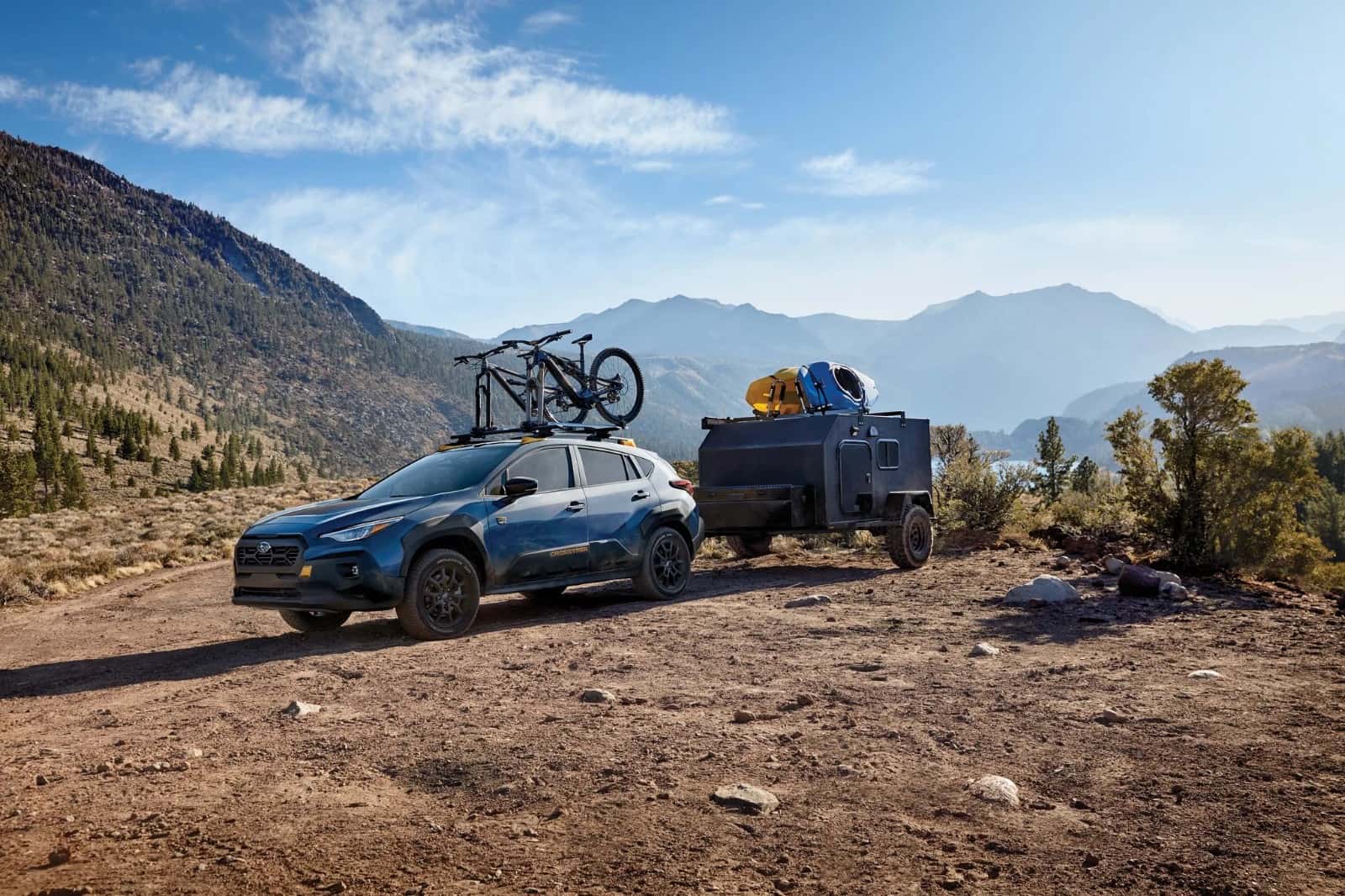 SUBARU IN THE LAS VEGAS DESERT · SUBARU OF LAS VEGAS
How does Vegas heat affect how long a Subaru CVT lasts?
CVT fluid breaks down faster in sustained 110°F heat than at 70°F — a known property of synthetic lubricants. That's why we inspect CVT fluid every 12,000 to 15,000 miles in the Las Vegas valley from May through September, instead of waiting for Subaru's severe-service interval (25,000 miles on older models, 60,000 on the current generation). Our shorter cadence is matched to what we actually see in the fluid out here.
Two heat sources stack on a Vegas drive: the 110°F outside, plus the heat the transmission makes in stop-and-go on the 215, the I-15 to Pahrump, or the Henderson-to-Strip commute. The fluid starts every trip hotter than it should, and once that happens it cycles on itself:
- Heat breaks the fluid down.
- The fluid loses grip, so the belt or chain slips slightly.
- Slipping makes more heat.
- More heat breaks the fluid down faster.
The Lineartronic is a sealed unit with no dipstick, so a true level check means a lift, a fill plug, and bringing the fluid to temperature. For a condition check, though, we can draw a drain-plug sample and read its color and smell in under 30 minutes. Burnt or darkened fluid tells us a lot; for hard wear-metal numbers, that's a lab oil analysis. Fluid pulled at 20,000 miles in Vegas summer often shows the same wear as fluid pulled at 40,000 miles in a cooler climate.
Mt. Charleston weekend drivers face a separate stressor: the ~6,500-foot climb from the valley floor to Lee Canyon puts the CVT under sustained high-load belt engagement for 40 miles, then engine-braking compression load on the descent. Both are manageable with fresh fluid — and damaging when it's degraded.
Warning signs of Subaru CVT trouble.
Five symptoms mean your Subaru CVT needs a professional inspection. If you see any of these, don't wait for the next scheduled service.
| Symptom | What it usually means | When to act |
|---|---|---|
| Shudder at 25–45 mph | The belt is slipping because the fluid has lost its grip | This week |
| Delayed Park-to-Drive engagement | Low internal pressure — usually the pump or torque converter | Do not wait |
| Speed-dependent whine | Bearing failure in pulley shaft (distinct from diff/transfer case whine) | This week |
| Burning smell after highway run | Fluid past thermal breakdown threshold | Same day if recurs |
| CVT or Check Engine light | Control module threshold exceeded; transmission in limp-home mode | Same day |
Source: Symptom causes and urgency from RepairPal — Subaru CVT reliability data, NHTSA CVT complaint database (P0700-series OBD-II), and the Subaru of Las Vegas service drive.
The shudder at 25–45 mph is the most commonly reported early-stage symptom, per RepairPal and NHTSA complaint data. Caught at that stage, a fluid drain-and-fill often resolves it without hardware replacement. The CVT warning light triggers a limp-home mode (P0700-series codes) — don't keep driving when it's on.
 SUBARU IN THE DESERT · SUBARU OF LAS VEGAS
Maintenance that extends Subaru CVT life in Las Vegas.
Four things extend Subaru CVT life in Las Vegas heat — all routine services we run on the schedule below.
| Service | Subaru interval | Our Las Vegas recommendation | Why it differs |
|---|---|---|---|
| CVT fluid drain-and-fill | 25,000 mi (older) / 60,000 mi (current) | 12,000–15,000 mi | Subaru CVT fluid breaks down faster in sustained desert heat |
| CVT fluid condition check | At each fluid service | Every 12,000 mi (Apr–Oct) | Summer heat accelerates color and odor changes |
| Cooling system check | Every 30,000 mi / 2 yr | Same — do not extend | The CVT sheds heat into the engine radiator |
Source: Subaru intervals from the Subaru of America scheduled maintenance guide and the Lineartronic CVT owner's manual. Las Vegas recommendation from the Subaru of Las Vegas service drive, calibrated to what we see in fluid samples through summer.
Subaru ships four non-interchangeable Lineartronic fluids (CVTF-II, CVTF-III, High Torque CVTF, CVTF LV) — the correct one depends on your VIN. We've traced shudder complaints on Foresters and Outbacks directly to prior non-Subaru-spec fills, confirmed by sample analysis. The CVT cooling circuit also shares coolant with the engine on most Lineartronic models, so a weak engine thermostat or degraded coolant raises CVT baseline temperature; that's why the 30,000-mile cooling-system check stays on the schedule.
On Vegas winter mornings below 45°F, give the car 2–3 minutes of gentle driving before sustained highway acceleration. Cold-start belt-pulley contact loads are higher than at operating temperature, and a slow first mile brings the fluid to viscosity without thermal shock.
 2026 SUBARU OUTBACK · SUBARU OF LAS VEGAS
Subaru Added Security: what CVT coverage looks like.
Subaru Added Security (Subaru's extended service plan) covers the Lineartronic CVT under its Powertrain tier. That includes the CVT housing, internal components, and the transmission control module.
The baseline Subaru factory powertrain warranty covers 5 years or 60,000 miles. Subaru Added Security extends powertrain coverage up to 10 years and 100,000 miles depending on the plan tier (current tier structure available from us in writing on request). For Las Vegas owners, SAS coverage provides documented protection against CVT hardware failures that go beyond what a fluid service can correct.
SAS coverage applies at any authorized Subaru retailer. Subaru of Las Vegas is an authorized SAS service location. If you are considering SAS at vehicle purchase, ask our finance team at Contact us for a written quote with the specific coverage tiers and deductible options. We provide it in writing before any contract is signed.